Posts

"Look, Duck, Vanish!": magicians in the Home Guard
Image
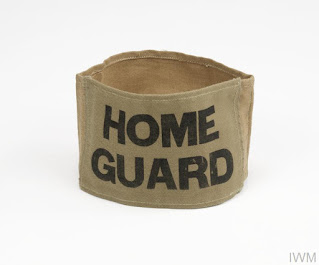
On the evening of 14 May 1940, four days after Germany invaded France and the Low Countries, newly appointed Secretary of State for War, Anthony Eden, gave a speech on the B.B.C. Home Service: “ Since the war began, the government have received countless enquiries from all over the kingdom from men of all ages who are for one reason or another not at present engaged in military service, and who wish to do something for the defence of their country. Well, now is your opportunity. We want large numbers of such men in Great Britain, who are British subjects, between the ages of seventeen and sixty-five…to come forward and offer their services…The name of the new force which is now to be raised will be ‘The Local Defence Volunteers'". And so, the L.D.V. (later renamed the 'Home Guard' by Winston Churchill) was formed. Within 24 hours, a quarter of a million men signed up.  Home Guard armband (Source: Imperial War Museum) The L.D.V. – or Home Guard – consisted mainly of tho...

"A magician is an actor playing the part of a magician"

Image
Famed  Nineteenth  Century magician and illusionist, Jean-Eugene Robert-Houdin, once wrote, " a magician is an actor playing the part of a magician ".  During wartime, mov ies provided war-weary audiences an escape from the turbulence and sacrifice of war, while also providing an opportunity for nations to boost morale, through government-funded propaganda films.  Some  World War Two-era magicians were also actors, appearing in movies made between 1939-1945 to entertain the public. The most famous of these was James Stewart. Before becoming a world-famous movie star, Stewart started out as an amateur magician, partnering with fellow magician Bill Neff. He was a member of the International Brotherhood of Magicians and contributed several tricks to magic magazines. Turning to acting, Stewart appeared in more than 90 films, television programmes, and shorts.  He starred in 12 films between 1939-1941, including Mr. Smith Goes to Washington (1939), It's a Wonde...

Louis Van Dyck joins the Belgian resistance

Image
Born into a family of traveling fairground performers specialising in magic,  Louis Van Dyck (1897-1959)  appeared on stage from an early age. After his father died suddenly at the age of 44, Louis' mother Elisabeth took on the act. To appear less Flemish, she changed the family's stage name to Vanda (and later Wanda). Newly billed as Les Vanda Illusionnistes , Elisabeth, Louis, and his sister Jeanne, toured Belgium and France with their trio magic act until the onset of World War One. Louis Van Dyck - child magician (Source:  Suzy Wandas: The Lady with the Fairy Fingers , 2019) Les Vanda Illusionnistes - Elisabeth, Jeanne and Louis Vanda (Source: Public domain) After Louis turned eighteen, he volunteered for the Belgium Army. He completed two months of basic training in France, before being sent to the front in 1916. He served with the 3rd Regiment of the Line in Belgium's 1st Army Division, experiencing the horrors of trench warfare first hand. In the end, the hars...

Entertaining Hitler: Gogia Pasha, the gilly-gilly man (and war worker)

Image
Gogia Pasha (1910-1976) fooled the world by pretending to be an Egyptian for most of his career. In fact, he was born Danpat Rai Gogia in British India.  Gogia originally trained as a doctor and had studied medicine in Cairo and Edinburgh. But, he abandoned medicine to turn to the stage. Donning a turban and a set of brightly coloured robes, Gogia adopted the persona of a 'gilly-gilly' (or ‘gali-gali’) man, after the Egyptian slang for magic.    He became an established act, touring internationally with a large troupe, mostly his family; and even appearing in several movies.   According to historian John Zubrzycki: “ Gogia’s shows combined comedy, comment and humorous patter with tricks, and incorporated dancers between sets. His signature acts included cups and balls, producing live chickens from his mouth and a levitation feat where his assistant was placed upon the points of three swords, two of which were removed, leaving only one under her neck to supp...

H.M.S. Wizard

Image
‘Warship Weeks’ were national campaigns to raise money to buy extra ships for the British Royal Navy. Other government-sponsored fundraising campaigns included 'Wings for Victory' weeks to buy bombers, 'Spitfire Week', 'War Weapons Week' and a 'Tanks for Attack' week. Similar campaigns were ran by other nations. The aim of ‘Warship Week’ was for individual cities, or collections of towns and villages, to raise money to pay for battleships, cruisers or destroyers. Once enough money had been raised to build the ship, the local community would adopt it.  Warship Week poster (Source: The National Museum of the Royal Navy, © Trustees of the NMRN) Women’s institutes, churches and schools would provide additional comforts for the crews of the ship they had adopted. This was usually in the form of woollen socks, gloves and balaclavas. Children would often write letters and send cards to the crew. When possible, officers and men from the adopted ship would visit ...

Controversial edition of Hitler's Mein Kampf translated by magician

Image
With war looming, one of the most popular books was Adolf Hitler’s auto-biographical manifesto,  Mein Kampf  (1925). Readers across the Channel and across the Atlantic wanted to understand what made the madman in Germany tick.  English translations of   Mein Kampf   were available, but they had been mired in complications and controversy since the early 1930s. One translation, known as the Stackpole edition, came out in America in February 1939.  It was translated, anonymously, by journalist and part-time magician, June Burrows Mussey (1910-1985). American publisher Stackpole Sons, promised to handover profits from sales of the book to refugee charities. But, a copyright claim by a rival American publisher, which ended up in the United States Supreme Court, stopping publication of this edition after only four months. Mussey’s translation sold 12,000 copies in its short run.   Mussey (who performed as Henry Hay) went on to serve in an air intellige...