Posts

Leslie Lambert: enigmatic Bletchley Park code-breaker

Image
Leslie Lambert was a founding member of The Magic Circle in 1905. But, he disappeared from the magic  community  just before World War One. Years later, he reappeared, as a  B.B.C. broadcaster, under the  pseudonym  A. J. Alan. Members of The Magic Circle recognised his voice, and knew the real identity of this popular radio storyteller. But what they didn't know, was that Lambert had another career... as a code-breaker. A founding member of The Magic Circle (the premier magic society in the U.K.), Leslie Harrison Lambert (1883-1941) was  a well-regarded magician. He appeared several times at the 'Home of Mystery', St. George's Hall, London and at numerous Magic Circle events, becoming one of the society's Vice Presidents. He was known as a " bright star " in the magic community, commended for his sleight of hand ability and originality. He performed especially at society events, and appeared before Queen Mary and The Prince of Wales (Edward VIII) twic...

Paul Potassy: "Magic saved my life"

Image
In this incredible  personal  story, magician Paul Potassy gives a thrilling first-hand account of how magic literally saved his life during winter operations in World War Two...  Austrian by birth, Paul Potassy (Paul Ludwig Alexander of Potassy) (1923-2018) developed an early interest in magic and was performing in cabaret and other public venues before he finished high school. With the German annexation of Austria in 1938, the family was relocated to Berlin, where Paul got to see many top magic acts of the day. He went on to university to study engineering. But, he wanted to become a professional magician and, in 1940, he joined the German Magic Circle as its youngest member.  Soon after, World War Two intervened to halt his plans. He was conscripted into the Germany Army in November 1941 and sent off to complete his basic military training on the Eastern Front. Paul Potassy in military uniform (1942) (Source: 'Heroes of Magic' by John Fisher) Fifteen months later,...

Operations MAGIC and MAGIC CARPET

Image
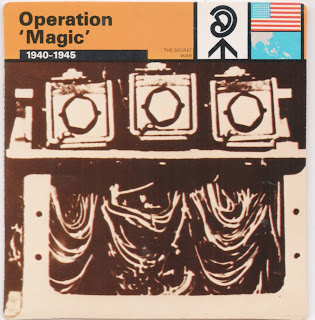
This blog takes a quick look at two military operations with magical names, Operation MAGIC and Operation MAGIC CARPET: Operation MAGIC As the British worked to crack German military codes, the Americans had a similar programme to intercept and read coded Japanese messages.  In a nod to the world of magicians, i t was called ‘Operation MAGIC’. On 25th September, 1940, an intelligence team led by Colonel William Friedman cracked the 'Purple' code the Japanese were then using for their top-secret diplomatic messages. The MAGIC programme, devoted to decoding Japanese radio traffic, was under way not long afterwards. But, American cryptologists had not broken all the Japanese codes by late 1941. This explains why the State Department and wider U.S. Government did not have a complete picture of Japanese plans to attack Pearl Harbor. Despite the failure of Operation MAGIC to adequately predict Japan’s opening more, its value was undisputed and it remained in use to the end of the war...

"Don't be fright!": radio magician's catchphrase helps reassure the nation

Image
Sirdani was the most popular magician to entertain on British radio during World War Two.  Over the airwaves, he entertained millions of people, bringing  light   relief  to dark times. Although he played the role of an Egyptian gilly-gilly man, Sirdani's real name was Sid Daniels. He was born in Mile End, London in 1899. World War One broke out when Daniels was 16 years old.  Like many others, he enlisted by falsifying his age. He went on to serve in three campaigns, in West Africa, German East Africa and France.  A keen amateur magician, Daniels used to mystify his fellow soldiers in the trenches with his tricks. It was when shells came whining over just as he was in the middle of a particularly interesting bit of magic that he originated his famous phrase, "Don't be fright" . After his discharge from the army, Daniels took up magic full-time. He adopted the name Sirdani and the persona of an Egyptian gilly-gilly man.   Early in his career he perform...

Magic Circle History Day 2026: The Magic Man of Amsterdam - The lost story of Louis Lam

Introduction In my presentation on Louis Lam’s life, I demonstrated a colour changing deck routine. A spectator freely selected a card from a red backed deck, and its back changed to blue. Its matching card, taken from a blue backed deck, changed to red. When the decks were examined, every card in each pack had also changed back colour.  Watch the performance here: The routine combined two of Louis Lam’s colour changing deck effects: The Movie Colour Cards and Coloro . Both are explained below in Louis’ own words. [1] To combine the two effects, I made several changes. The first change was to use only one deck for The Movie Colour Cards . Instead of using a double backer and secretly reversing it, I placed an ordinary card from the differently coloured deck on top, so a blue backed deck appeared to be red backed. I reinforced this impression with the Hindu Shuffle Display. I then attached a small piece of double-sided tape to the back of that red card. [2] After the displ...